
Neighbours guide · Notice, hours and protection
Demolition and
your neighbours
Notice, working hours, dilapidation reports, shared fences and dust controls decide whether a demolition goes smoothly with the people next door. Here is what applies and who arranges it.
Gabrael House Demolition · Published · Updated
In this guide
A quote for your property
Share the address and your plans. We will arrange a free site assessment.
Free site assessment1300 329 6007am to 7pm, seven days
Giving neighbours notice
A house demolition affects the people next door more than almost any other residential job: several days of machinery, trucks on the street, dust, and a boundary that suddenly has nothing on the other side of it. Most of the friction can be avoided by telling neighbours what is happening, when, and who to call, before the fencing goes up.
Notice is also a formal requirement in most cases. For demolition carried out under a Complying Development Certificate (CDC), the NSW Planning Portal states that neighbours within 20 metres of the boundary must be notified before work starts: at least seven days’ notice in metropolitan areas, and two days in rural and regional areas and residential release areas. Where the demolition is approved under a Development Application (DA), the notification requirement is set by the consent conditions, and councils differ: some ask for a set number of days, some require a letterbox drop within a stated radius, some require a sign on the fence with the contractor’s contact details. Check the approval, then check with the council or certifier if it is silent. Our demolition approvals guide explains how to read those conditions.
Written notice should cover the expected start date, the likely duration, working hours, the site contact’s name and phone number and a note about any planned road or footpath use. Gabrael provides a notice for the site and confirms with you who is delivering it, but the obligation sits with the person carrying out the development, so keep a copy and a record of the date it was given.
Working hours
Permitted hours depend on the approval pathway, and neighbours are entitled to know which one applies.
- Complying development. The Codes SEPP conditions for demolition under a CDC allow work only between 7.00am and 5.00pm, Monday to Saturday, with no demolition on Sundays or public holidays.
- Development consent. Hours are set by the consent conditions. Many Sydney councils adopt the standard hours recommended in the NSW EPA’s Interim Construction Noise Guideline, which are 7.00am to 6.00pm on weekdays and 8.00am to 1.00pm on Saturdays, with no work on Sundays or public holidays. Some councils set tighter Saturday hours, or restrict noisy work such as rock breaking to a shorter window within the day.
Those are the outer limits, not a target. Truck movements before the permitted start, and machinery warming up at the fence line, are the usual complaints. We schedule deliveries and machine start-up inside the approved hours and include the hours on the neighbour notice so nobody has to guess. If a council or certifier imposes different hours for your site, the condition on the approval prevails over any general figure in this guide.
Dilapidation reports and who commissions them
A dilapidation report is a written and photographic record of the condition of neighbouring buildings, fences, driveways and public footpaths taken before work starts. If a crack or a displaced fence post is claimed afterwards, the report shows whether it was already there. It protects the neighbour as much as the owner, and it is routinely required.
The NSW Government’s best practice conditions of consent (previously called the standard conditions) for residential development include a dilapidation report before site work begins, prepared by a suitably qualified person, covering adjoining buildings, structures and public land. Many councils apply it to demolition consents, and some CDC approvals carry a similar condition. Even where it is not a condition, it is worth commissioning when the house shares a wall, stands close to a boundary, or the demolition involves breaking up a slab or footings next to a neighbouring structure.
Who arranges it:
- The report is commissioned by the owner or developer, usually through a building consultant, engineer or surveyor who is independent of the demolition contractor. We can recommend that it be done and coordinate access, but we do not prepare it ourselves.
- The consultant contacts each neighbour to arrange an inspection. A neighbour can decline, in which case the report records that access was refused and documents what can be seen from the boundary and the street.
- A copy is given to each neighbour whose property was inspected. Some consents require a copy to be lodged with the council or certifier before work starts.
- A follow-up inspection after demolition, or after any excavation, closes the record.
The consultant’s fee is an external cost. It is quoted by the consultant and is not part of the demolition price.
Party walls, shared fences and the boundary
Semi-detached houses, terraces and some older duplexes share a wall on the boundary. Demolishing one side of a pair is a different job from a freestanding knockdown: the shared wall stays, has to be supported and weatherproofed as the attached structure comes away, and may reveal an unrendered or unsound face that was never meant to be exposed. It is engineered work, needs the neighbour’s cooperation and often the consent of both owners, and is assessed separately at the site inspection. Do not assume a standard house demolition scope covers it.
Dividing fences are a more common issue. Under the NSW Dividing Fences Act 1991, a boundary fence is normally the joint responsibility of the adjoining owners, so a fence that is removed to allow machinery access, or damaged during demolition, is a matter between the owner and the neighbour rather than something the contractor can settle unilaterally. Before work starts, agree in writing whether any fence is to be removed, protected or replaced, and note its condition in the dilapidation report. Asbestos cement fencing is common on fibro-era blocks and is handled as asbestos rather than as fencing; see our fibro and asbestos guide.
Boundary structures on the neighbour’s side, including retaining walls, garden beds and services that cross the line, are identified during the site assessment and protected or excluded from the scope. Where a survey is needed to find the boundary, that is arranged before demolition, not after.
Dust, noise and vibration controls
Demolition is not silent or dust-free. What the approval and good practice require is that both are controlled.
- Dust: water is applied while the structure is being pulled down and while material is loaded; stockpiles are kept damp; sediment controls stop wash-off reaching the gutter and stormwater system; and loads leaving the site are covered. Asbestos removal has its own wet-work and containment rules and happens before the excavator starts.
- Noise: work stays inside the approved hours; the noisiest tasks, such as breaking concrete, are grouped rather than spread across the week; plant is maintained so reversing alarms and engines are not louder than they need to be.
- Vibration: slab breaking and footing removal near a neighbouring structure are done with the method matched to the distance from the boundary. Where the dilapidation report identifies a fragile structure next door, the method changes.
- Trucks and access: truck movements are scheduled inside working hours, the footpath is kept clear where possible, and any use of the road or footpath for bins, cranes or standing vehicles has the council’s permission first.
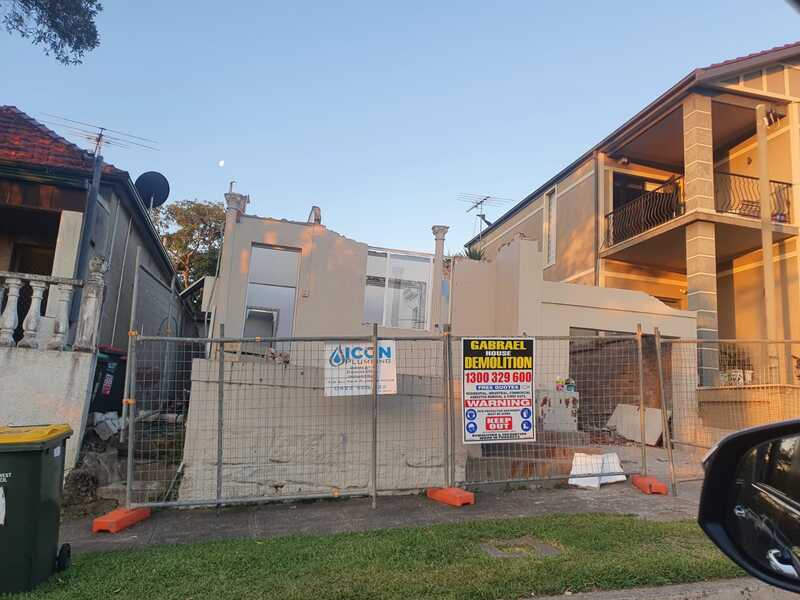
Site fencing and signage go up before work starts and stay until the block is handed over. The fencing is a safety measure, and it also marks where the neighbour’s property begins.
A single point of contact
Most neighbour concerns are resolved by having a name and a phone number that actually answers. The notice identifies the site supervisor, and the approval usually requires the contractor’s details to be displayed on the site. If a neighbour raises something during the work, the supervisor is the first point of contact on site; if it concerns hours, dust or damage, it is recorded. Complaints made to the council or the certifier are handled through them and can stop work, so it is in everyone’s interest that the first call goes to the site.
If damage to a neighbouring property is alleged, the dilapidation report is the reference point. Gabrael carries $20M public liability insurance; a genuine claim is dealt with through that cover, not argued over the fence.
Bring the approval conditions, the site plan and anything you already know about shared walls, fences and difficult access to the house demolition site assessment. We will identify the notice, hours, protection and reporting requirements for your block, tell you which items are yours to commission, and set out in the written quote how the site will be run. Common questions about preparation and handover are answered in our FAQs.

Zac, Director, Gabrael House Demolition
Zac runs Gabrael’s jobs on site. The family business has served Sydney since 1995 and holds restricted demolition licence DE2 AD202697 and Class B non-friable asbestos removal licence AD211249.
About our team and credentialsStart with your property
Plan the site around the neighbours.
Share the approval conditions and anything you know about shared walls, fences or access. We will identify the notice, hours and reporting requirements and set out how the site will be run.