
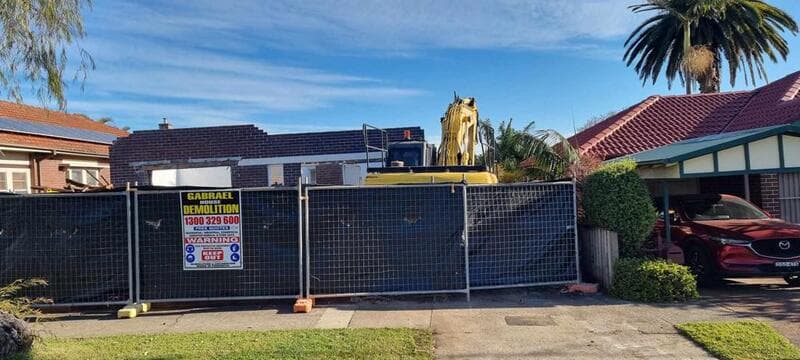
Process guide · From assessment to handover
The house demolition process
and how long it takes
The excavator is only one part of the job. See how inspection, approvals, asbestos work and disconnections lead into demolition, recycling and the agreed handover, and how long each stage takes.
Gabrael House Demolition · Published · Updated
In this guide
A quote for your property
Share the address and your plans. We will arrange a free site assessment.
Free site assessment1300 329 6007am to 7pm, seven days
1. Assess the property and agree the work
Start with the address, what you want removed and what needs to remain. Gabrael’s free site assessment considers the structure, access, nearby buildings, existing services and suspected asbestos. Share your building plans, available reports and proposed schedule.
The written quote establishes the scope
Your quote should identify the structures, foundations and other works included, the asbestos assessment and removal arrangements, approvals coordination, external fees and site handover. House categories have different inclusions; further excavation or preparation for your builder may need a separate allowance.
Use the house demolition cost guide for early budgeting. The final quote follows inspection rather than an itemised online calculation.
2. Arrange approvals, asbestos work and disconnections
Confirm permission to proceed
Gabrael coordinates the demolition application and council or certifier liaison within the agreed scope. The property determines the approval pathway and conditions. Confirm those conditions and the pre-start requirements before booking work. Our permit guide explains the questions to resolve.
Assess materials before disturbance
Suspected asbestos needs assessment to establish its type, condition and extent. Our Class B licence AD211249 covers non-friable removal. Friable asbestos is removed by our Class A licensed partner.
Allow for the required notification, removal and clearance arrangements before the relevant demolition work. If unexpected suspect material is found later, work in the affected area must pause for assessment. Read the asbestos guide for the distinctions between inspection, removal and clearance.
Coordinate utilities and services
Electricity, gas, water, telecommunications and other services need appropriate disconnection or protection arrangements. Gabrael coordinates with the relevant providers and trades. Agree which services are to be disconnected, any services that need to remain, and who pays provider charges. Confirmation of completed disconnections is a pre-start check, not an assumption. The electricity abolishment usually has the longest lead time, so it often sets the earliest start date; our utility disconnections guide covers each service in order.
3. Prepare the site and neighbours
The team establishes fencing, signage and the protection measures needed for the property. Machinery access, truck movements, dust control and nearby buildings influence how the site is set up. Traffic arrangements and use of public land must follow the applicable requirements.
Keep the work predictable
Agree the required neighbour notifications, working hours and contact person for site concerns. Explain access restrictions before work starts so deliveries, shared driveways and neighbouring property can be considered.
Identify anything you want to keep
Remove personal belongings before the agreed start and tell the team about fixtures, architectural features or reusable items you want retained. Salvage needs to be agreed before demolition and assessed against the condition of the building and materials. Do not start removing suspect asbestos or structural elements yourself.
4. Demolish and sort materials
The agreed sequence may include an internal strip-out followed by structural demolition. The crew uses equipment and methods suited to the building, access and licence scope, with dust suppression and protection of neighbouring property throughout the work.
Slabs, footings and underground structures are addressed as specified in the quote. Their removal should not be assumed from the phrase “house demolition”; confirm what your next build requires.
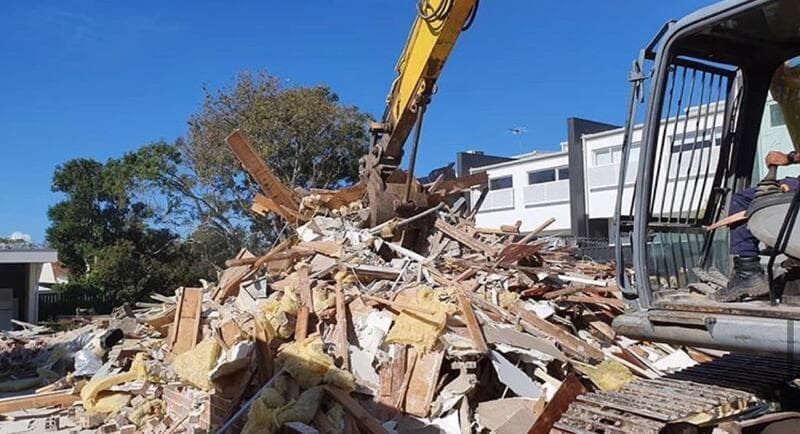
Gabrael recycles over 85% of demolition materials, sorting concrete, timber and metals for appropriate recycling facilities (see what happens to demolition waste). Asbestos waste is handled separately and taken to approved disposal facilities.
5. Clean up and complete the agreed handover
The team removes debris and completes the levelling, compaction or other preparation included in the quote. A cleared demolition site and the prepared block your builder needs can involve different work, so agree the finish against the building plans before starting.
At handover, review the completed scope and collect the completion certificate, relevant disposal records, asbestos clearance documentation and any required sign-offs. Keep these records with the project documents for your builder.
If your project needs further excavation or preparation, see our site preparation service.
How long a house demolition takes
Once approvals, asbestos work and disconnections are complete, demolishing a Sydney house takes roughly 2 to 3 working days on site for a small home, 3 to 5 for a medium home and 5 to 7 for a large one. The whole project, from first contact to a cleared block, takes longer, because the approval and the utility disconnections each run on their own timetable and neither is controlled by the demolition contractor.
| Stage | Indicative duration | Who controls it |
|---|---|---|
| 1. Site assessment and written quote | Arranged after your enquiry; the quote follows the inspection | You and Gabrael |
| 2. Approval (DA or CDC) | Varies with the pathway, the property and the information requested; plan in weeks, sometimes longer for a DA | Council or registered certifier |
| 3. Utility disconnections | Allow several weeks from lodgement; confirm with each provider | Retailers, network operators, licensed trades |
| 4. Asbestos survey, notification, removal and clearance | Survey and laboratory results first; SafeWork NSW notified at least five days before licensed removal; removal time depends on quantity and access | Assessor, licensed removalist, SafeWork NSW |
| 5. Site set-up | Usually completed in the days before the start, once pre-start conditions are met | Gabrael |
| 6. Demolition on site: small house | 2 to 3 working days | Gabrael |
| 6. Demolition on site: medium house | 3 to 5 working days | Gabrael |
| 6. Demolition on site: large house | 5 to 7 working days | Gabrael |
| 6. Demolition on site: very large or complex | Assessed individually; staged where required | Gabrael |
| 7. Cleanup, levelling and handover | Included in the on-site period for the agreed scope | Gabrael |
| 8. Further site preparation | Separate scope, quoted after assessment | Gabrael or your builder |
Stages 2, 3 and 4 can overlap: disconnection requests usually go in as soon as the approval looks likely, and asbestos removal is often done while the last disconnection is being completed. The critical path for most projects is the longest of those three stages, not the demolition itself.
What “working days on site” includes
The on-site figures run from the crew arriving to the block being handed over as described in the quote: any internal strip-out the method calls for, structural demolition, breaking out the slab and footings to the agreed extent, sorting and loading materials, and the final cleanup and levelling. Weekends, public holidays and days when weather makes the site unsafe are excluded. Size and construction decide the band; access, outbuildings, pools and the amount of concrete in the ground push a house towards the top of it.
What changes the timeline
- A request for further information on the application, or a condition that needs a separate report before work can start.
- Disconnection scheduling, especially electricity abolishment or an nbn equipment removal that was requested late.
- Asbestos found after work starts. Work in that area pauses for assessment, and removal is added to the program.
- Access. Narrow driveways, battle-axe blocks and street parking restrictions reduce the size of machine and truck that can be used.
- Concrete in the ground. Thick slabs, deep footings, pools and old tanks add days at the end of the job.
- Weather. Heavy rain stops work on clay sites and delays compaction and levelling.
- Neighbour and council matters. A missing dilapidation report or a complaint about hours can stop work until it is resolved. See the neighbours guide.
- Handover scope. Site cut, compaction testing and trenching for a builder are additional work with their own duration.
Planning your build date
Share your builder’s proposed start date at the site assessment. Lock in the demolition date only once the approval is granted and the disconnection dates are confirmed, then give the builder a handover date with a margin for weather and ground conditions. The steps to complete before the crew arrives are in our before-demolition checklist, and the handover for a knockdown rebuild is covered in the builder handover guide.
What to have ready
- The property address, plans and any existing approvals.
- A clear list of structures to remove and items to retain.
- Existing asbestos reports or information about suspect materials.
- Access restrictions and the builder’s handover requirements.
- Your proposed schedule and the best person to contact.
Gabrael has served Sydney since 1995. Our 2025 Australian Trades Small Business Champion win and 2024 APAC asbestos recognition are part of that history. We can discuss the work and arrange a free assessment for your property.

Zac, Director, Gabrael House Demolition
Zac runs Gabrael’s jobs on site. The family business has served Sydney since 1995 and holds restricted demolition licence DE2 AD202697 and Class B non-friable asbestos removal licence AD211249.
About our team and credentialsStart with your property
Start with the property and your plans.
Share what needs removing, what must remain and your proposed building schedule. A free site assessment helps establish the scope and sequence.