
Asbestos guide · Fibro houses
Fibro houses and asbestos:
what to know before demolition
Fibro-era homes often contain bonded asbestos, but age is a reason to test rather than a result. Here is where it usually sits, how it is confirmed, what our Class B licence covers and how it affects the quote.
Gabrael House Demolition · Published
In this guide
A quote for your property
Share the address and your plans. We will arrange a free site assessment.
Free site assessment1300 329 6007am to 7pm, seven days
What “fibro” means for a demolition
Fibro is the everyday name for fibre cement sheeting, and in Sydney it usually means the flat and corrugated sheets used on thousands of post-war homes, garages, sleep-outs and fences. Until the 1980s, most fibre cement made in Australia was asbestos cement: cement bound with asbestos fibre. Later products used cellulose fibre instead, and look similar from the street.
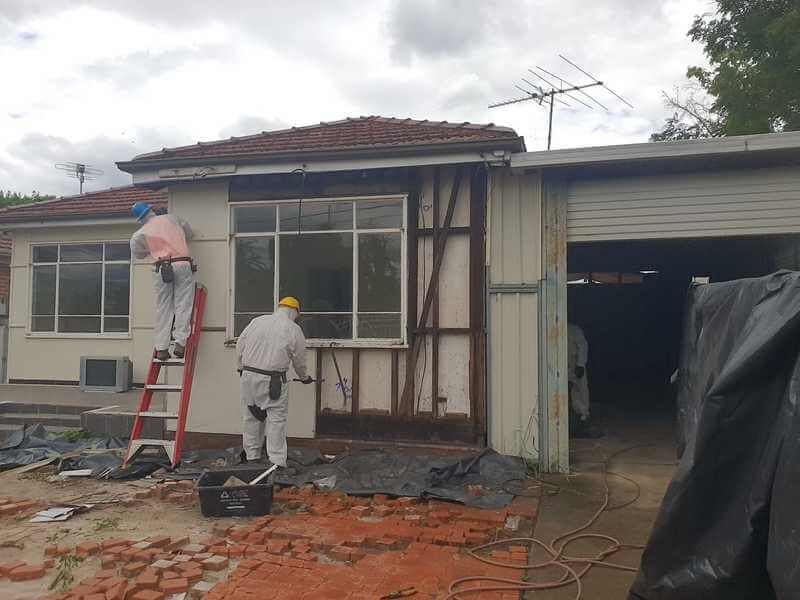
That is why a fibro house needs a particular kind of planning before demolition. The sheeting is usually bonded asbestos, which is stable while it stays intact but releases fibre if it is broken, cut, sanded or run over by an excavator. The demolition method, the licence needed and the disposal route all follow from what the material actually is. This guide sets out where asbestos is likely to be, how it is confirmed, what our Class B licence covers and what changes when it does not.
Where bonded asbestos usually sits in a fibro house
The list below is where asbestos cement and other bonded products are commonly found in houses of this era. It is a prompt for the assessor, not a substitute for testing. Any of these may turn out to be asbestos-free, and asbestos can also appear somewhere not on the list.
- External wall cladding: flat sheets with cover strips over the joints, or planks fixed like weatherboards.
- Eaves, soffits and gable linings: often the last original sheeting left after the walls have been reclad in brick veneer or vinyl.
- Roofing: corrugated asbestos cement, sometimes under a later metal roof, and ridge capping and guttering made of the same material.
- Wet areas: bathroom, laundry and kitchen wall linings, splashbacks and the sheeting behind tiles.
- Internal walls and ceilings: flat sheets in sleep-outs, enclosed verandahs and later additions.
- Floor coverings: vinyl tiles, sheet vinyl backing and the adhesive under them.
- Fences, sheds and garages: corrugated fencing panels and outbuildings built from off-cuts. See garage, shed and carport demolition.
- Services: flue pipes, downpipes, water pipes, the backing board of an old electrical meter box and insulation around heaters.
Brick veneer and weatherboard homes of the same period often contain the same materials in eaves, wet areas and outbuildings. The cladding alone does not settle the question either way.
Testing versus assuming
Under NSW work health and safety rules, material that is likely to contain asbestos can be assumed to be asbestos and treated accordingly, or it can be sampled and analysed by a laboratory. Both are legitimate. For a demolition, the difference is practical.
Assuming everything suspect is asbestos means the whole lot must be removed under licence and disposed of as asbestos waste before the house comes down, including materials that might have been ordinary fibre cement. Testing lets an assessor separate confirmed asbestos from clean sheeting, which can reduce the removal scope and the volume of waste going to a licensed landfill rather than a recycler.
Testing is not something to do yourself. Taking samples disturbs the material, and a sample from one wall says nothing about the roof. An independent licensed asbestos assessor or a competent person inspects the house, takes samples where needed, sends them to a NATA-accredited laboratory and records the results. The age of the house is a reason to investigate. It is not a result.
Class B versus Class A materials
SafeWork NSW licenses asbestos removal in two classes, and the class follows the material rather than the size of the job.
- Non-friable (bonded) asbestos is bound in cement, vinyl or resin and cannot be crumbled by hand when dry. Fibro sheeting, corrugated roofing, vinyl tiles and cement pipes are the usual examples. Removing more than 10 square metres needs at least a Class B licence.
- Friable asbestos can be crumbled or reduced to powder by hand pressure. Loose-fill insulation, pipe lagging, sprayed coatings and badly weathered or fire-damaged sheeting fall into this group. Removing any amount needs a Class A licence.
Gabrael holds Class B non-friable asbestos removal licence AD211249. That covers the bonded materials listed above, removed intact where possible, wetted down, wrapped and taken to a licensed facility. It does not cover friable material. If the assessment identifies friable asbestos, or bonded sheeting that has degraded to the point of being friable, that part of the work is carried out by our Class A licensed partner and is quoted separately. Our non-friable asbestos removal service explains the scope in more detail.
Licensed removal also carries a notification duty: the removalist must notify SafeWork NSW before licensed removal work starts, currently at least five days ahead. That notification period sits inside the project timeline and cannot be skipped to meet a demolition date.
Loose-fill asbestos insulation (Mr Fluffy)
A small number of NSW homes had raw amosite or crocidolite asbestos pumped into their ceilings as insulation in the 1960s and 1970s by a company that traded as Mr Fluffy. This is friable asbestos in its most hazardous form, and it migrates into wall cavities, subfloors and cornices.
NSW Fair Trading maintains a register of properties confirmed to contain loose-fill asbestos insulation, and the NSW Government has run a program under which affected homes are demolished with comprehensive site remediation. If a property is on that register, or an inspection finds loose fibrous material in the ceiling space of a pre-1980 house, it is not quoted as a standard demolition. Friable asbestos is removed by our Class A licensed partner, and loose-fill work also needs a licensed asbestos assessor, air monitoring and a remediation scope that goes well beyond removing sheeting. Check the register at the Fair Trading website before you buy or plan to demolish a home of that era.
The asbestos register and clearance paperwork
Three documents matter, and they are produced at different stages.
- The asbestos survey or register. Prepared before any work, it records what was inspected, what was sampled, the results and where each material is located. For a demolition, a “demolition” or “pre-demolition” survey is more intrusive than a management survey because the assessor can open up cavities that would otherwise be left alone.
- The asbestos removal control plan and SafeWork notification. Prepared by the licensed removalist, these set out how the identified material will be removed, contained, wrapped and transported, and record that SafeWork NSW was notified.
- The clearance certificate. After removal, an inspection confirms the area is free of visible asbestos and dust before demolition proceeds. For Class B work this inspection can be done by a competent person or a licensed asbestos assessor; either way, they must be independent of the removal work. Class A work requires a licensed assessor and air monitoring.
Keep the survey, the notification reference, the waste disposal dockets and the clearance certificate together. Your builder, your certifier and a future purchaser may all ask for them. They are part of the handover package described in our FAQs.
How asbestos affects the quote
Our published house demolition price bands already account for asbestos differently by category: the small-house category includes an asbestos inspection, and the medium and large categories list bonded asbestos as assessed and quoted within our Class B scope, rather than bundled into the band. The house demolition cost guide sets out those inclusions. Beyond that, the asbestos component of a quote is settled after the site assessment and, where needed, the survey results. The factors are:
- The quantity of bonded material, measured in square metres, and how many separate locations it is in.
- Whether it can be removed intact (sheets unscrewed and lowered) or is fixed in a way that forces breakage.
- Height and access: roofing and gable ends need scaffolding or elevated work platforms.
- Condition: weathered, painted-over or fire-affected sheeting takes longer and may be reclassified as friable.
- Whether any friable material is found, which moves that part of the work to our Class A licensed partner.
- Disposal volume, since asbestos waste goes to a licensed landfill rather than a recycler and attracts its own charges.
- Clearance inspection and, where required, air monitoring by an independent assessor.
If suspect material turns up after demolition has started, work in that area pauses for assessment and we discuss any change to the scope with you before continuing. A written quote that names the surveyed materials, the licence class each one needs and who is doing the removal is easier to compare than a single line that says “asbestos included”.
Before you book
Bring any existing asbestos reports, the property’s age and construction, and photos of the eaves, wet areas and outbuildings to the site assessment. We will explain whether the material appears to sit within our Class B scope, what needs sampling and how the removal and clearance steps fit ahead of the house demolition itself. For the broader sequence of assessment, removal and clearance, read our asbestos removal guide.

Zac, Director, Gabrael House Demolition
Zac runs Gabrael’s jobs on site. The family business has served Sydney since 1995 and holds restricted demolition licence DE2 AD202697 and Class B non-friable asbestos removal licence AD211249.
About our team and credentialsStart with your property
Assess the material before the excavator.
Send the address, the age of the house and any existing asbestos reports. We will explain what needs sampling, what sits within our Class B scope and how removal fits ahead of demolition.